
Last updated 31 July 2026
She has stopped noticing the snoring, because after eleven years of marriage it has become the sound the room makes at night. What she notices is the silence. The snoring builds, then stops completely, and the quiet stretches out for far longer than feels right. She lies there counting. Then comes a choked gasp, the snoring restarts, and he sleeps on, entirely unaware that anything has happened. In the morning he complains that he is tired again, and he blames the traffic and the office.
That pattern has a name. It is obstructive sleep apnoea, and it is a breathing disorder rather than a bad habit. The silence is the dangerous part, not the noise.
Snoring itself is extremely common in this country. A community study of 1,611 adults aged 30 to 70, published in the journal Respirology in 2007, found that 47.3 percent of Malaysian adults were habitual snorers. Around one in seven reported breathing pauses during sleep. About 7 percent of the group were clinically suspected of having obstructive sleep apnoea. So the snoring is not the unusual finding. What happens inside a minority of those snorers is.
What obstructive sleep apnoea actually is
When you fall asleep, the muscles that hold your throat open relax along with everything else. In most people the airway stays open regardless. In some people it narrows so much that the walls touch and the airway closes.
An apnoea is a complete stop in airflow that lasts at least ten seconds. A hypopnoea is a partial collapse, where airflow falls substantially but does not stop. Both do the same thing to your body. Oxygen in the blood begins to fall, carbon dioxide begins to rise, and the brain registers an emergency.
The brain’s response is to wake you up, very briefly, just enough to restore muscle tone in the throat. The airway snaps open, often with a loud gasp or snort, and breathing resumes. The arousal is so short that you will not remember it in the morning.
Then you fall asleep again, the throat relaxes again, and the whole cycle repeats. In severe cases this happens more than thirty times an hour, all night, every night. The person in the bed believes they have slept for seven hours. Their brain has been rescuing them from suffocation the entire time.
Why this is not simply snoring
Snoring is the sound of soft tissue vibrating in a narrowed airway. Most snorers do not have sleep apnoea, and plain snoring on its own is mostly a social problem.
Obstructive sleep apnoea is different in kind, not merely in volume. It combines two separate injuries, repeated hundreds of times a night. The first is intermittent hypoxia, meaning the oxygen level in your blood keeps dropping and recovering. The second is sleep fragmentation, meaning you never stay long enough in the deep and restorative stages of sleep to benefit from them.
That is why the daytime symptoms are so distinctive. It is not ordinary tiredness. It is falling asleep at traffic lights, in meetings and in front of the television, sometimes without any warning at all.
The signs worth taking seriously
- Loud snoring that can be heard through a closed door.
- Someone has witnessed you stop breathing, gasp or choke during sleep.
- You wake unrefreshed even after a full night, and you often have a morning headache.
- You feel overwhelmingly sleepy during the day, especially while driving or sitting still.
- You wake repeatedly to pass urine at night, which is a real and under-recognised feature.
- Your concentration, memory or mood has deteriorated and no one can explain why.
- You have high blood pressure that stays high despite several medications.
The STOP-BANG questions
Doctors need a fast way to decide who deserves a sleep study. The commonest screening tool is STOP-BANG, and the Ministry of Health’s Clinical Practice Guidelines on the Management of Obstructive Sleep Apnoea, published in 2023 and hosted by the Academy of Medicine Malaysia, cover screening among their recommendations.
Each letter is one yes or no question, and each yes scores one point.
| Letter | The question |
|---|---|
| Snoring | Do you snore loudly, loudly enough to be heard through a closed door? |
| Tiredness | Do you often feel tired, fatigued or sleepy during the daytime? |
| Observed | Has anyone observed you stop breathing, choke or gasp during your sleep? |
| Pressure | Do you have high blood pressure, or are you being treated for it? |
| BMI | Is your body mass index above 35? |
| Age | Are you older than 50? |
| Neck | Is your neck circumference larger than 40cm? |
| Gender | Are you male? |
A score of 0 to 2 suggests a low risk of obstructive sleep apnoea. A score of 3 or 4 puts you at intermediate risk, and a score of 5 to 8 puts you at high risk. Anything from 3 upwards is worth a conversation with your doctor.
Two cautions belong with this questionnaire. It screens, and it cannot diagnose, so a high score is a reason for a sleep study rather than a conclusion. And the BMI threshold of 35 was drawn from Western populations. Research in Asian populations has found obstructive sleep apnoea occurring at lower body mass index values, partly because of differences in jaw and facial structure. A slim Malaysian with a low STOP-BANG score can still have the condition, so symptoms should always be taken seriously.
Women are frequently missed. They are more likely to describe fatigue, insomnia, low mood or morning headaches than the classic picture of thunderous snoring, and the diagnosis is often delayed for years.
What a sleep study actually involves
The diagnostic test is called polysomnography. You spend a night in a sleep laboratory, in what is usually a normal bedroom rather than a hospital ward.
A technician attaches sensors before you sleep. Small electrodes on your scalp and face record your brain waves and eye movements, which is how the machine knows what stage of sleep you are in. Bands around your chest and abdomen record your breathing effort. A small sensor at your nose measures airflow, a clip on your finger measures your blood oxygen, and a microphone records the snoring. None of it is painful and none of it involves needles.
A simpler home sleep apnoea test is also available in many places. It records fewer channels, and it can confirm the diagnosis in people who are strongly suspected of having it. It is less useful in complicated cases or when the result is likely to be borderline.
The main output is a single number, the apnoea-hypopnoea index, usually shortened to AHI. It is the average number of breathing events per hour of sleep.
| AHI, events per hour | Severity |
|---|---|
| Fewer than 5 | Normal |
| 5 to 14 | Mild obstructive sleep apnoea |
| 15 to 29 | Moderate obstructive sleep apnoea |
| 30 or more | Severe obstructive sleep apnoea |
An AHI of 30 means your breathing was interrupted at least once every two minutes, throughout the night.
What it does to the rest of the body
Every apnoea produces a surge of stress hormones as the body fights to reopen the airway. Blood pressure rises sharply, the heart rate swings, and the whole sequence repeats hundreds of times before morning. Over years, that has consequences well beyond feeling tired.
- Hypertension. Obstructive sleep apnoea is a recognised cause of high blood pressure, and it is particularly common in people whose blood pressure refuses to come down despite three or more medications.
- Cardiovascular disease. Untreated sleep apnoea is associated with coronary artery disease, heart failure and irregular heart rhythms such as atrial fibrillation. Our article on the early warning signs that your heart may be in trouble covers what to watch for.
- Stroke. The condition is an independent risk factor for stroke, over and above the raised blood pressure that so often accompanies it.
- Worse diabetes control. Fragmented sleep and repeated oxygen dips worsen insulin resistance. If you have diabetes, our guide on how diabetes increases heart risk explains why these conditions compound each other.
- Road traffic accidents. This is the most immediate danger of all.
The driving risk deserves its own paragraph. A systematic review published in the Journal of Clinical Sleep Medicine found that drivers with obstructive sleep apnoea have a crash risk roughly two and a half times that of drivers without it. The Malaysian community study mentioned earlier also linked suspected sleep apnoea and habitual snoring with driving and workplace accidents. Untreated severe sleep apnoea and a long drive home on the highway are a dangerous combination.
CPAP, and why people abandon it
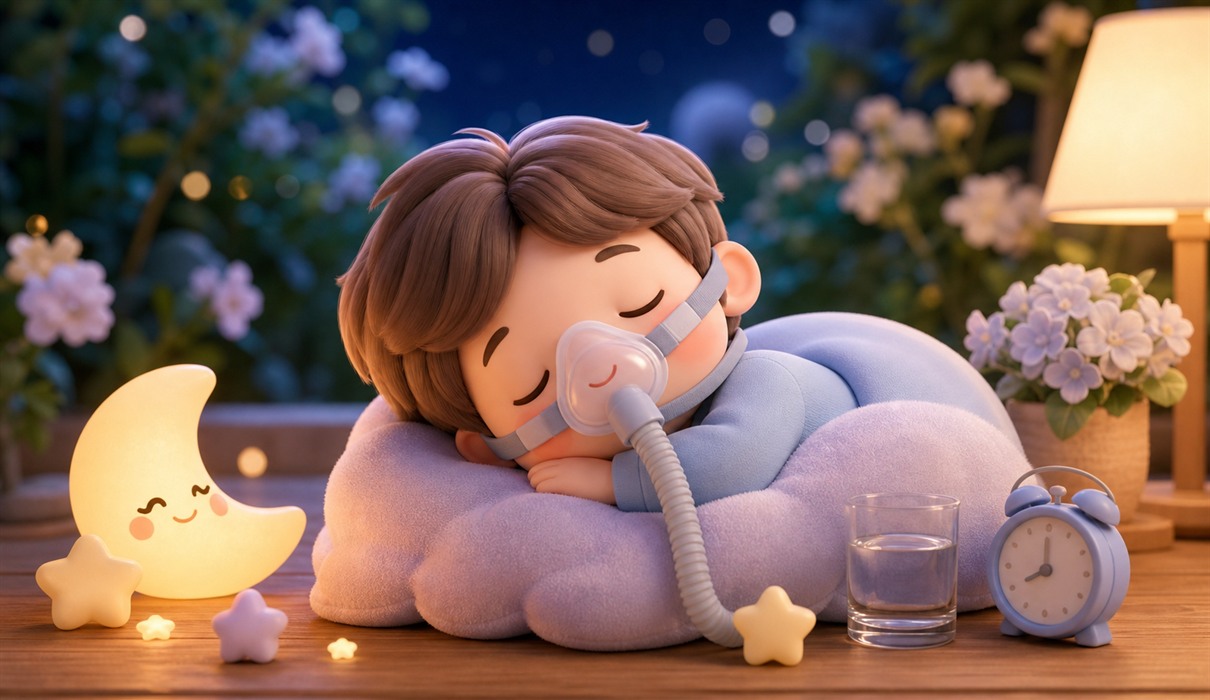
The main treatment for moderate and severe disease is continuous positive airway pressure, known universally as CPAP. A small pump sends gently pressurised air through a tube into a mask. That column of air acts as a splint, holding the throat open so it cannot collapse.
The machine does not breathe for you and it does not deliver oxygen. It simply keeps the airway from closing, and when it is used properly it works. Snoring stops on the first night. Daytime sleepiness usually improves within weeks, and blood pressure often falls.
The difficulty is that many people stop using it. Studies have found that somewhere between 30 and 50 percent of patients abandon CPAP within the first year, and many stop far sooner than that. The reasons are consistent and, importantly, most of them are fixable.
- The mask does not fit. This is the commonest reason of all, and masks come in several designs and sizes. A leaking mask is a fitting problem, not a personal failure.
- It feels claustrophobic. Smaller nasal pillow masks suit many people who cannot tolerate a full face mask.
- The pressure feels too strong at the start. Almost every machine has a ramp setting that begins low and builds up gradually as you fall asleep.
- The air is dry and the throat is sore. A heated humidifier attachment usually solves this within a night or two.
- It is inconvenient and unglamorous. That is a fair complaint, and it has to be weighed against a stroke.
The first month determines almost everything. People who are supported through the early weeks, with adjustments to the mask and the pressure, tend to keep using the machine for years. People who are handed a machine and left alone tend to give up. If you are struggling, go back and ask for it to be adjusted rather than putting it in the cupboard.
The treatments that are not CPAP
Weight loss. This is the one treatment that can reduce the severity of the disease itself. Fat around the neck and inside the throat narrows the airway, and fat around the abdomen reduces lung volume, which makes the airway easier to collapse. A long-running cohort study published in JAMA in 2000 quantified it. A 10 percent loss of body weight predicted a 26 percent fall in the AHI, and a 10 percent gain predicted a 32 percent rise. That cuts both ways, and it is worth knowing in advance.
Mandibular advancement devices. These are custom-made dental appliances that hold the lower jaw slightly forward during sleep, which opens up the space behind the tongue. They are an option in mild and moderate disease, and for people who cannot tolerate CPAP. They must be fitted by a dentist, because the versions sold without a fitting can damage your bite.
Positional therapy. In a substantial number of people, the apnoeas happen mainly or entirely while lying on the back, because gravity pulls the tongue and soft palate backwards. Staying off your back can meaningfully reduce the number of events. The traditional trick is to sew a tennis ball into the back of a sleeping shirt, and purpose-made positional devices now exist. This is worth asking about, because your sleep study report will usually state how many of your events happened on your back.
Alcohol and sedatives. Both relax the muscles of the throat and both make obstructive sleep apnoea worse. Avoiding alcohol in the hours before bed is a free intervention.
Surgery. An ear, nose and throat surgeon may find a specific obstruction that can be corrected, such as enlarged tonsils or a badly blocked nose. Surgery is not a routine first treatment for adults, and it is not a substitute for CPAP in most cases.
What to do tonight, and what to ask for
Some of this you can start immediately, without waiting for an appointment.
- Ask whoever sleeps near you what they actually hear. A witnessed pause in breathing is the single most useful piece of information you can bring to a doctor.
- Record yourself. A phone left running beside the bed captures the snoring, the silences and the gasps, and a doctor will take that seriously.
- Score yourself on STOP-BANG. It takes two minutes, and a score of 3 or more is a reason to make an appointment.
- Sleep on your side tonight. It costs nothing, and for some people it reduces events considerably.
- Skip the alcohol and the sleeping tablet. Both make the airway more collapsible.
- Do not drive when you are sleepy. If you have ever nodded off at the wheel or drifted out of your lane, treat that as an emergency and stop driving until you have been assessed.
At the appointment
- Ask for a referral for a sleep study, and ask whether a home test is appropriate for you.
- Ask for your AHI number when the result comes back, and ask how many of your events occurred while you were on your back.
- If CPAP is prescribed, ask who will review the mask fit and the pressure in the first month.
- If you cannot tolerate CPAP, ask about a mandibular advancement device rather than simply stopping treatment.
- Ask for your blood pressure and your blood sugar to be checked, since both are commonly affected.
When to see a doctor
Make an appointment if you snore loudly and anyone has seen you stop breathing. Make one if you are sleepy during the day in a way that affects your work, your driving or your mood. Make one if your blood pressure will not come down despite treatment.
Insufficient sleep is already widespread here. The National Health and Morbidity Survey 2023, run by the Institute for Public Health, found that 38 percent of adults in Malaysia sleep less than seven hours a night. Sleep apnoea is a different problem again, because it damages the quality of the sleep you do get. Someone can lie in bed for eight hours and still wake up exhausted, night after night, and never know why.
Loud snoring on its own is a nuisance. Loud snoring with pauses, gasps and daytime sleepiness is a medical condition with a treatment. It is worth finding out which one you have. Read more in our respiratory health section.
A note on this article. This is general health information, not personal medical advice. Everyone’s situation is different, and this article cannot account for your medical history, your medications, or your current condition. Always speak to your doctor or pharmacist before changing your diet, starting a supplement, or acting on anything you read here. If you are worried about your symptoms, contact your nearest clinic or hospital.
Guidelines and figures change over time. The information here reflects the sources available when this article was last updated, shown at the top of the page. Where a national guideline or registry is named, check the latest edition for the current position.